
UTP Patch Panel 48 Port: The Backbone of Modern Network Infrastructure
In today’s increasingly connected world, reliable network infrastructure is no longer a luxury—it is a necessity. Whether in corporate offices, data centers, or telecommunications rooms, ensuring seamless connectivity for hundreds or even thousands of devices requires robust networking equipment. Among the unsung heroes of modern networking stands the UTP Patch Panel 48 Port, a critical component that streamlines network management and enhances system performance.
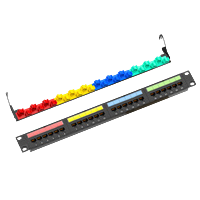
A UTP (Unshielded Twisted Pair) Patch Panel is a hardware unit featuring multiple ports designed to terminate and organize network cables. Specifically, the 48-port variant provides a high-density solution capable of handling a large volume of connections within a compact form factor. This makes it ideal for medium to large-sized enterprises or data centers where space optimization and cable management are paramount.
One of the primary advantages of a 48-port UTP patch panel is its ability to simplify complex cabling environments. By consolidating multiple network connections into a single, organized interface, IT administrators can easily identify, manage, and troubleshoot connections. This centralized design reduces downtime caused by mismanaged cables and facilitates faster maintenance operations. Additionally, it allows for a cleaner installation, minimizing clutter in network racks and improving airflow around critical equipment, which in turn contributes to the longevity of networking devices.
The versatility of the 48-port UTP patch panel is another key reason for its widespread adoption. It supports a wide range of Ethernet standards, including Cat5e, Cat6, and even Cat6a cabling, allowing organizations to upgrade their network infrastructure without needing to replace the entire panel. This backward and forward compatibility ensures that businesses can scale their network as demands increase while protecting prior investments in cabling.
Moreover, a well-designed UTP patch panel incorporates features that enhance both performance and durability. High-quality panels often come with labeled ports for easy identification, rear cable management bars to maintain proper bend radius, and robust metal chassis to withstand physical stress. These design elements not only improve operational efficiency but also help in maintaining signal integrity, which is critical for high-speed data transmission.
The installation process of a 48-port patch panel has been streamlined to accommodate both seasoned professionals and new IT personnel. Typically, the panel is mounted in a standard 19-inch rack, with each port terminating one network cable. Color-coded labels and modular punch-down blocks simplify the wiring process, ensuring consistency and reducing the likelihood of errors. For larger setups, multiple panels can be daisy-chained or connected to network switches, forming a highly organized and scalable infrastructure.
From a market perspective, the demand for UTP patch panels 48 port has been steadily increasing due to the rapid expansion of cloud computing, IoT devices, and smart office environments. Businesses are increasingly recognizing the value of organized cabling, not just for operational efficiency but also for cost savings over time. Proper cable management reduces wear and tear, prevents accidental disconnections, and ensures network reliability, which is vital in sectors like finance, healthcare, and e-commerce, where downtime can result in substantial financial losses.
In addition, environmental considerations are becoming more prominent. Modern patch panels are designed to be energy-efficient, reducing unnecessary power consumption associated with cooling overpopulated racks. Compact, high-density panels like the 48-port UTP model enable organizations to maintain effective network management while minimizing environmental impact.
Looking forward, the evolution of networking technologies will continue to influence the role of UTP patch panels. With the advent of 10G Ethernet and beyond, future patch panels will need to support higher bandwidths, better shielding, and improved thermal management. However, the fundamental principle remains: a well-organized patch panel, particularly a 48-port model, serves as the backbone of reliable and efficient network infrastructure.
In conclusion, the UTP Patch Panel 48 Port is more than just a hardware accessory; it is a critical enabler of modern network efficiency. Its high-density design, ease of management, scalability, and durability make it indispensable in data centers, corporate networks, and telecom environments. As businesses continue to demand faster, more reliable network connections, investing in quality patch panels ensures a solid foundation for both current and future networking needs. The 48-port UTP patch panel embodies the perfect balance between capacity, performance, and organization, proving that even in an age of wireless connectivity, structured cabling remains essential.
Latest news & events

Mar 17,2026
Keystone Jack: Essential Component for Modern Networking Solutions
Newest Keystone jack brands offer high-performance, reliable, and versatile connectors for modern networking needs
Learn more
Mar 12,2026
Network Cable Boots Enhancing Protection and Reliability in Modern Cabling Systems
China Network Cable Boots factory produces premium PVC covers that protect Ethernet connectors and ensure stable data flow
Learn more
Mar 11,2026
RJ45 Connector: The Essential Interface Driving Modern Network Connectivity
In the rapidly evolving world of digital communication, reliable data transmission is fundamental to the functioning of modern networks. One of the most widely used components enabling this connectivity is the RJ45 connector
Learn more

HYCONNECT provides integrated solutions for cabling infrastructure system copper and fiber. The major components including Cat5e/6/6A/7/8 keystone jack,patch panel,faceplate,plug and cable management,fiber optic patch cable,adapter,and fiber patch panel
No. 240, New Zhoutang Road, Qiaotou Town, Cixi City , Ningbo Zhejiang, China
